


 1-888-674-4601


Insights
Launching Small-Group Math Instruction – How to Start Rotations and Targeted Teaching Early
Small-group math rotations is a cornerstone of effective elementary teaching. By meeting students in smaller settings, teachers can address diverse needs, provide targeted support, and encourage deeper mathematical thinking. Launching math groups early in the year sets the tone for personalized learning and allows routines to become part of classroom culture from day one.
When done well, rotations not only make differentiation manageable but also give students ownership of their learning. Whether you’re new to small-group instruction or looking to refine your approach, early planning and consistent structures make all the difference.

Setting the Tone for Math Rotations
Beginning math groups at the start of the year helps students quickly understand expectations, routines, and responsibilities. Instead of waiting until mid-year, introducing small groups early:
- Builds independence and accountability.
- Normalizes flexible grouping and targeted teaching.
- Helps teachers identify strengths and gaps sooner.
- Creates an engaging, student-centered math environment.
Early rotations ensure that small-group learning doesn’t feel like an “add-on” but a natural part of daily math instruction.

Establishing Structures for Math Rotations
The key to successful small-group instruction lies in clear routines. Students need to know what to do when they’re not working directly with the teacher, which is why meaningful, engaging stations matter.
A rotation model often includes three components:
- Teacher-led small group – targeted instruction on specific skills.
- Independent or partner practice – reinforcing previously taught skills.
- Math centers or tasks – open-ended problem-solving, games, or explorations.
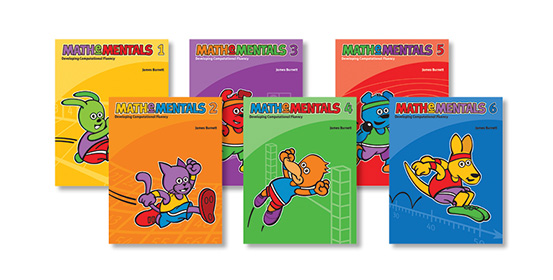
Resources like ORIGO Think Tanks and Mathementals provide ready-to-go, problem-solving tasks and quick activities that are perfect for independent or partner work during rotations. Because they are designed to encourage reasoning and collaboration, they keep students engaged while the teacher focuses on guided instruction.
Launching Small Groups in the First Weeks of School
Introducing rotations doesn’t have to be overwhelming. The first few weeks are about building stamina and modeling expectations.
- Start with one station at a time. Teach, practice, and reinforce what successful behavior looks like before adding more.
- Keep activities simple at first. Familiar games or number sense tasks help students focus on the process rather than the content.
- Model transitions explicitly. Practice moving between groups, cleaning up materials, and resetting stations.
- Build in reflection. Use a few minutes after rotations for students to share what went well or what needs improvement.
By scaffolding the process, students learn that small-group math time is structured, predictable, and productive.

Targeted Teaching in Small Groups
The heart of rotations is the teacher-led group. This is the time to address misconceptions, extend thinking, and differentiate instruction based on formative assessments.
- Use data wisely. Exit tickets, math journals, and quick checks can help group students effectively.
- Focus on one clear objective. A 10–15 minute small-group lesson should zoom in on a specific skill or concept.
- Encourage discourse. Even in a small group, math talk builds confidence and deepens understanding.
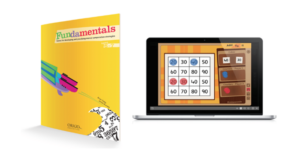
ORIGO Fundamentals offers digital practice activities that align with key skills, making it easy to assign differentiated tasks before or after small-group sessions.
Also, as part of the Stepping Stone’s curriculum, ORIGO’s Student Journals give students structured opportunities to record their thinking, providing teachers with valuable insight into how students are processing new concepts.
Examples by Grade Range
K–2: Building Number Sense
Young learners benefit from hands-on exploration and repeated exposure to foundational concepts. Small groups might focus on counting strategies, composing and decomposing numbers, or subitizing.

Examples of small-group activities:
- Dot Card Flash: Show students a card with 4–6 dots arranged in different patterns. Have them quickly recognize (“subitize”) how many without counting each dot.
- Build a Number with Counters: Give a number (like 7) and have students show it in different ways using linking cubes, two-color counters, or buttons (e.g., 5 + 2, 4 + 3).
- Ten Frame Fill: Provide partially filled ten frames and ask students how many more are needed to make 10, reinforcing composing and decomposing.
- Count and Cover Game: Roll a die, count out that many objects, and cover the matching numeral on a board. Great for connecting counting to numerals.
- Make 10 Memory: Use cards showing pairs of numbers that add up to 10 (e.g., 3 and 7). Students turn over cards, trying to find a “make 10” match.
- Which One Doesn’t Belong? Show groups of objects (e.g., 5, 6, 7, 10) and ask which number or set “doesn’t belong” and why, encouraging number reasoning.

Use ORIGO Number Cases to provide tactile tools like dot cards and ten frames that build strong number foundations.
These kinds of activities build fluency and flexibility without relying on rote drills, while keeping learning engaging and student-centered.
Grades 3–4: Strengthening Multiplication and Division
As students transition to more complex operations, small-group instruction can target fact fluency and conceptual understanding of multiplication and division.

Examples of small-group activities:
- Array Builders: Give students tiles or grid paper and have them build arrays for facts like 4 × 6 or 3 × 8. Discuss how arrays show both multiplication and division relationships.
- Fact Family Triangles: Provide sets of three numbers (e.g., 6, 4, 24) and have students generate the related multiplication and division equations.
- Skip Count Races: Students roll a die, then skip count by that number up to 100, reinforcing multiplication patterns.
- Equal Groups Sort: Present a set of objects (like 24 counters) and challenge students to sort them into different equal groups (2 groups of 12, 3 groups of 8, 4 groups of 6) to see connections.
- Real-World Word Problems: Pose scenarios like “If 4 friends share 28 apples equally, how many apples do they each get?” Encourage multiple solution strategies.
- Multiplication Card Game: Use a deck of cards (2–10). Students flip two cards and multiply them; the highest product wins. For variation, have them solve the related division problem.
- Missing Factor Mystery: Write a number sentence with a missing factor (e.g., __ × 7 = 56). Students work together to solve and explain their reasoning.
- ORIGO Mathementals activities make excellent warm-ups for small groups, encouraging quick recall through low-pressure games.
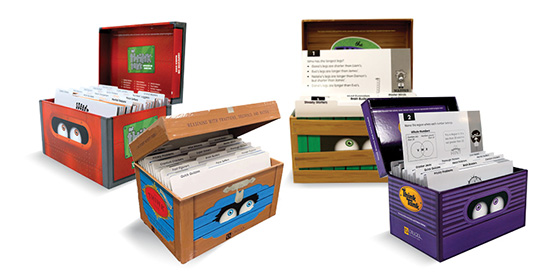
ORIGO Think Tanks offer rich, open-ended problems that challenge students to apply multiplication and division in real-world contexts.
These activities reinforce fact fluency, highlight the inverse relationship between multiplication and division, and promote reasoning through concrete and engaging practice.
Grades 5–6: Deepening Fraction and Decimal Understanding
Upper elementary students often need extra support with fractions and decimals. Small groups allow teachers to address misconceptions directly while offering extension opportunities for advanced learners.
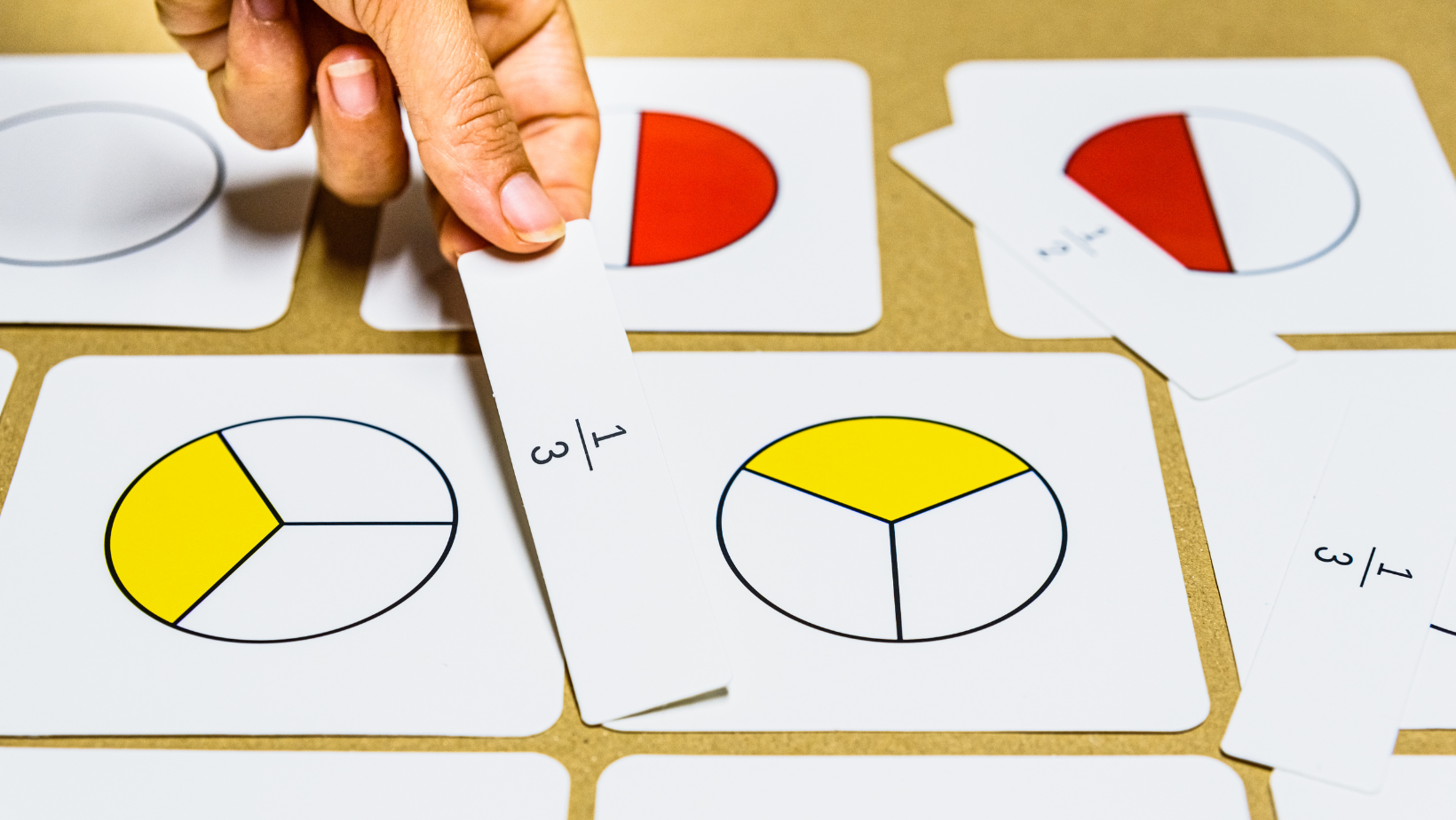
Examples of small-group activities:
- Fraction Comparison with Number Lines: Have students place fractions (like 3/8 and 1/2) on a number line and justify which is greater. Extend to comparing decimals (0.6 vs. 0.58).
- Equivalent Fraction Sort: Provide fraction cards (e.g., 2/3, 4/6, 6/9) and ask students to group equivalents together, explaining why they are the same.
- Decimal War: Using a deck of number cards, students create decimal numbers and compare them. Highest decimal wins, reinforcing place value.
- Fraction-Decimal Match: Match cards showing fractions (like 3/4) to their decimal equivalents (0.75). Challenge students with less common fractions like 7/20.
- Real-World Fraction Problems: Pose tasks such as, “A recipe calls for 3/4 cup of sugar, but you only have a 1/4-cup scoop. How many scoops do you need?”
- Adding and Subtracting with Models: Use fraction strips or grids to model problems like 2/3 – 1/4. Encourage drawing representations before computing.
- Decimal Operations in Context: Give word problems, e.g., “You have $20 and buy three items that cost $4.75 each. How much money is left?”
- Fraction of a Set: Present a set of 24 counters and ask, “What is 2/3 of 24?” Have students use multiple strategies (partitioning, multiplication).
These activities help solidify conceptual understanding while also preparing students for middle school math.
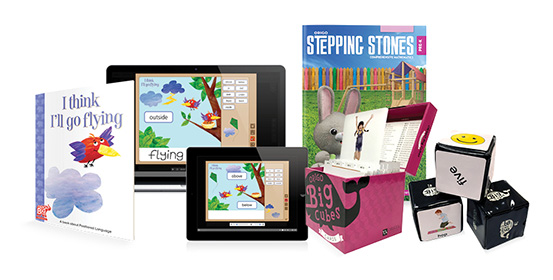
For more support, ORIGO’s Stepping Stones 2.0 curriculum provides a coherent structure that ensures fraction and decimal concepts build over time, giving teachers a clear roadmap for differentiation.

Keeping Small Groups Sustainable
Launching rotations is just the beginning—the challenge is keeping them running smoothly all year long. Here are some tips for sustainability:
- Rotate responsibilities. Assign student leaders to help manage materials and transitions.
- Plan ahead. Use a consistent weekly structure for stations so planning doesn’t become overwhelming.
- Refresh activities. Swap in new Think Tank tasks, journal prompts, or digital activities to maintain student interest.
- Celebrate progress. Highlight how small-group learning is helping students grow in confidence and skills.
Starting small-group math instruction early creates a culture of collaboration, independence, and personalized learning. With clear routines, engaging activities, and thoughtful use of resources, rotations can transform math instruction into a dynamic, student-centered experience.
Most importantly, by blending targeted teaching with meaningful independent tasks, teachers can maximize instructional time and ensure every student gets the support they need.

 1-888-674-4601