


 1-888-674-4601


Insights
Teaching Problem-Solving Skills from Day One in Elementary Math
Problem-solving is the heart of mathematics. It’s what gives meaning to numbers, operations, and patterns. As elementary math educators, we know that solving problems isn’t just something students do at the end of a unit—it’s a skill they need to build from day one. In fact, teaching problem-solving in math should begin the moment students walk into our classrooms at the start of the year.

Why Start Teaching Problem-Solving Skills from Day One?
From the very beginning, students should see math as more than just computation. In a 2018 study, Hanna Palmér and Jorryt van Bommel found that six-year-olds viewed problem-solving tasks as “fun and accessible.” As they engaged with the tasks, they used creativity and reasoning—an approach that boosted their confidence in math.
A similar report by Clements & Sarama found that high-quality early math learning, including problem-solving from preschool onward, fosters substantial, long-lasting growth in mathematics—and even benefits literacy!
Problem-solving is about thinking critically, making sense of a situation, and applying what you know in new ways. Starting early builds this mindset and helps students develop:
- Mathematical confidence
- Resilience when facing challenges
- Flexible thinking and reasoning skills
- A growth mindset about math
Waiting until later in the year to introduce problem-solving sends the message that it’s an “extra” skill, rather than a core component of learning math.

Embed Problem-Solving into Daily Routines
You don’t need a separate unit to begin teaching problem-solving in math. Incorporate it into your daily math block using simple strategies like:
- Number Talks: Ask open-ended questions like “How do you know?” or “Is there another way to solve it?”
- Math Warm-Ups: Use short, rich problems that require reasoning, not just fast facts.
- Think-Alouds: Model your own thinking process aloud when solving a problem, showing students how mathematicians make decisions and try different strategies.
- Partner Talk: Have students explain their reasoning to each other, reinforcing their understanding and communication skills.
These routines help students view math as a process of discovery and reasoning, not just getting the right answer.

Teach a Toolbox of Problem-Solving Strategies
Students often struggle because they don’t know how to begin. Explicitly teaching a set of flexible strategies gives them entry points for any problem:
- Draw a picture or diagram
- Use manipulatives or tools
- Look for patterns
- Make a table or chart
- Work backward
- Act it out
Create a problem-solving bulletin board or anchor chart and refer to it often. Encourage students to try different approaches and discuss which strategies worked best for a given problem.

Focus on the Process, Not Just the Answer
Too often, students are praised only when they get the correct answer. But teaching problem-solving means valuing the process—the reasoning, the representations, the perseverance. Celebrate:
- Multiple strategies used
- Clear explanations and reasoning
- Revising and improving ideas
- Making mistakes and learning from them
Provide feedback that highlights these efforts. For example, “I noticed you tried two different models before you found one that helped you solve it. That’s great perseverance!”

Use Real-World and Open-Ended Problems
Engage students with problems that are meaningful and have more than one possible solution or method. These might include:
- Story problems that relate to their lives
- Example (Younger Learners):
Liam has 24 apples. He wants to divide them into equal groups to give to his friends. What are some different ways he can do this?
→ Students can explore different group sizes (2, 3, 4, 6, 8, 12) and connect the task to multiplication/division and fair sharing. - Example (More Advanced):
You’re planning a birthday party for 8 friends. You have $100 to spend. Choose at least three items (e.g., food, drinks, decorations) and decide how much to spend on each. What’s your total? Will you stay under budget?
→ Involves estimation, addition/subtraction, and budgeting decisions. Multiple combinations are possible.
- Example (Younger Learners):
- Puzzles or math games
- Example (Younger Learners):
Snack Sharing
You have 12 crackers and 3 friends to share them with. How many different ways can you divide the crackers fairly?
→ This problem is easy to visualize and connects to real-life sharing. It encourages students to experiment with different groupings, use addition or subtraction, and explain their reasoning—all while building number sense. - Example (More Advanced):
24 Game:
Use exactly four numbers and any operations (+, −, ×, ÷) to make 24.
→ Students use order of operations and test different strategies. Multiple approaches are possible.
- Example (Younger Learners):
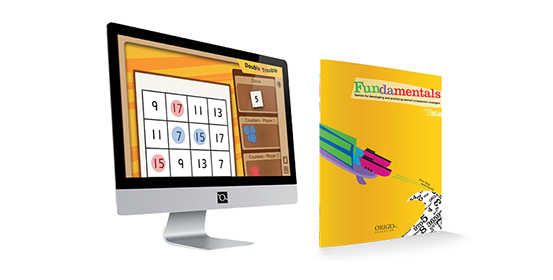
Try Fundamentals, our collection of classroom math games and strategies with over 200 mathematical number games that develop students’ ability to calculate mentally through pairs and small groupings. The games improve student discourse, problem-solving abilities and encourage appropriate mathematical language.
- Tasks that require reasoning, planning, and modeling
- Example (Younger Learners):
Design a zoo exhibit:
You have 12 fence pieces (use 12 toothpicks, craft sticks, or squares on grid paper). Use them to build a pen for your animal. What shapes can you make? Which pen gives your animal the most space?
** (Slightly more advanced) You have 40 feet of fencing. Draw a possible shape for your animal pen using grid paper. What’s the area of your pen? Could you make a different shape with the same perimeter?
→ Involves geometry, measurement, and spatial reasoning. Many correct answers. - Example (More Advanced):
Build a Lunchbox Menu:
Design a balanced lunch using the food chart and prices. Your lunch must cost less than $5, include at least 3 food groups, and total no more than 600 calories. Show your math.
→ Incorporates data interpretation, multiplication, and constraint-based decision making.
- Example (Younger Learners):
When students see that math can be creative and open to interpretation, they’re more willing to take risks and explore multiple pathways.


Leverage ORIGO Education’s Resources to Build Problem-Solving Skills
One of the most effective ways to build a strong problem-solving foundation is by using high-quality curriculum materials that promote thinking from the start. At ORIGO, our resources, including our flagship Stepping Stones 2.0 curriculum, are designed with problem-solving at the core.
How ORIGO Supports Problem-Solving in Math:
- Visual Models: ORIGO lessons often include concrete and pictorial models to support conceptual understanding, making it easier for students to grasp complex problems.
- Real-World Contexts: At ORIGO, word problems and tasks connect math to students’ everyday experiences, promoting relevance and engagement.
- Think Tanks: Our Think Tanks provide engaging, open-ended math tasks that encourage deep thinking and collaboration. Aligned with key concepts, these challenges are ideal for small groups or class discussions and are designed to promote reasoning, strategic problem-solving, and rich mathematical dialogue. With built-in support, Think Tanks allow all students to participate, making math more inclusive, thoughtful, and fun. Click HERE to try sample cards!
- Built-In Discussion Routines: ORIGO lessons include prompts and opportunities for student talk, peer feedback, and reflection—all essential for developing problem solvers.
Whether you’re new to ORIGO or a longtime user, our resources are crafted to nurture mathematical thinking at every stage of a student’s journey.

Encourage a Classroom Culture of Problem-Solving
Remember, ultimately, teaching problem-solving from day one is about building a culture where thinking is valued and mistakes are part of the learning process. Problem-solving isn’t a one-time lesson or end-of-unit challenge. It should be woven into every aspect of your math instruction. When we begin teaching problem-solving from day one, we give students the tools, mindset, and confidence they need to thrive in math and beyond.
With intentional routines, explicit strategy instruction, meaningful problems, and the support of resources like ORIGO Education’s curriculum, we can help every student become a confident and capable problem solver.
Ready to build a classroom of thinkers? Start on day one—and never stop.

 1-888-674-4601