


 1-888-674-4601


Insights
Helping Students Make Sense of Word Problems
For many elementary students, word problems are one of the most challenging parts of mathematics. A student may confidently solve a computation problem such as 8 + 5, but when that same idea appears within a story problem, the task suddenly feels much more complicated. Teachers often notice students rereading the problem, choosing the wrong operation, or focusing on numbers without understanding the situation being described.
Word problems require students to do more than compute—they must read, interpret, reason, and represent mathematical relationships. When students struggle with these tasks, it is not necessarily a sign that they cannot do the math. Instead, it often indicates that they need more support in decoding the structure and meaning of the problem.
Understanding why students struggle with word problems—and how teachers can help them make sense of them—can lead to stronger problem-solving skills and deeper mathematical understanding.

Why Word Problems Can Be Difficult for Students
Word problems combine several skills at once. Students must read and comprehend the text, identify relevant information, determine the mathematical relationship, and then carry out a solution strategy. When any of these steps break down, the entire process becomes difficult.
Language Demands
Word problems rely heavily on language. Students must interpret vocabulary, sentence structure, and contextual clues before they can even begin thinking mathematically. Phrases such as altogether, how many more, or left over signal mathematical relationships, but these cues are not always obvious to developing readers.
Students who are English-language learners—or who are still building academic vocabulary—may understand the mathematics but struggle to interpret the language used in the problem.
Identifying the Mathematical Relationship
Many students focus on the numbers in a problem rather than the relationship between quantities. They may attempt to apply a familiar operation simply because certain numbers appear together.

For example, when students see two numbers in a problem, they may automatically add them, even if the context suggests subtraction or comparison. Helping students slow down and analyze what the quantities represent is an essential step in strengthening problem-solving skills.
Translating Words Into Mathematical Representations
Another common challenge is moving from the story context to a mathematical representation. Students must decide how to represent the situation using equations, diagrams, or models. Without this step, students may attempt to guess the correct operation rather than reasoning through the problem.
Encouraging students to use visual models, tables, or drawings can make these relationships more visible and easier to understand.
Cognitive Load
Word problems require students to hold multiple pieces of information in their working memory at once. They must remember the context, identify important details, and determine what the question is asking—all before solving the problem.
Breaking the process into manageable steps can help reduce cognitive load and support more successful problem solving.

Helping Students Make Sense of Word Problems
When teachers explicitly model how to interpret and represent word problems, students gradually build the confidence and strategies they need to solve them independently. The goal is not simply to reach an answer, but to help students make sense of the mathematical situation.
Encourage Students to Visualize the Situation
Before reaching for an equation, students benefit from imagining what is happening in the problem. Asking students to draw the situation or represent it with objects can clarify relationships between quantities.
For example, if a problem describes students joining a group, drawing or modeling the groups can help students recognize that the quantities are being combined.
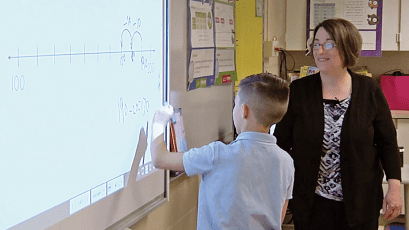
Visual representations—such as diagrams, number lines, or bar models—help students move from a story context to a mathematical structure.
Focus on Relationships, Not Keywords
For many years, students were taught to rely on keyword strategies when solving word problems. For instance, the word more was often associated with addition, while left suggested subtraction.
However, keywords can sometimes lead students to incorrect conclusions. Consider the question:
How many more apples does Maria have than Ben?
Although the word more appears, the problem actually involves comparing quantities, which may require subtraction.
Encouraging students to analyze the relationship between quantities leads to deeper understanding than relying on keywords alone.

Ask Questions That Promote Mathematical Reasoning
Teachers can guide students toward stronger problem-solving habits by asking questions such as:
- What is happening in this problem?
- What quantities are being compared or combined?
- What do we already know?
- What is the question asking us to find?
- How can we represent this situation?
These questions shift the focus from quickly finding an answer to understanding the structure of the problem.
Encourage Multiple Representations
Word problems become more accessible when students are encouraged to represent them in different ways. Some students may prefer drawings, while others may use equations or tables. Allowing students to choose representations helps them develop flexibility and strengthens their conceptual understanding.

Supporting Word Problem Skills With ORIGO Resources
High-quality instructional materials can play an important role in helping students develop stronger problem-solving skills. ORIGO Education resources are designed to support mathematical reasoning by encouraging students to explore relationships, represent ideas visually, and discuss their thinking.
Stepping Stones 2.0
ORIGO Education’s Stepping Stones 2.0 curriculum integrates problem-solving experiences throughout daily instruction. Rather than presenting word problems as isolated tasks at the end of a lesson, students regularly encounter mathematical situations that require them to analyze relationships and explain their reasoning.
The program emphasizes visual models and structured questioning, helping students connect story contexts to mathematical representations. These supports make it easier for students to interpret problems and develop strategies for solving them.

Think Tanks
The ORIGO Think Tanks provide rich mathematical tasks that encourage discussion and exploration. These problems invite students to analyze situations, share ideas, and consider multiple solution strategies.
Engaging with these open-ended tasks helps students strengthen their ability to interpret problems and reason through mathematical relationships—skills that are essential for tackling word problems successfully.
ORIGO One
ORIGO One offers short instructional videos and interactive resources that help clarify mathematical concepts. These tools support visual modeling and pattern exploration, allowing students to manipulate representations and observe relationships dynamically.
For students who struggle with translating story problems into mathematical structures, visual models can make the underlying relationships easier to see.
Additionally, ORIGO supports primary teachers across 14 countries through printed products, digital interactive resources, and professional learning, along with multilingual resources that help remove language barriers so all students can engage with mathematical ideas.
Check out ORIGO’s series on “Solving the Problem with Word Problems” listed below:
- Solving the Problem with Word Problems Part I
- Solving the Problem with Word Problems Part II: Addition and Subtraction
- Solving the Problem with Word Problems Part III: Multiplication and Division
- Solving the Problem with Word Problems Part IV: Beyond Whole Numbers

Building Confident Problem Solvers
Word problems are more than an assessment tool—they are an opportunity for students to apply their mathematical understanding in meaningful contexts. When students learn how to decode and represent these problems, they develop skills that extend far beyond a single lesson.
By helping students visualize situations, focus on relationships, and represent their thinking in multiple ways, teachers can transform word problems from a source of frustration into a powerful learning experience.

 1-888-674-4601