


 1-888-674-4601


Insights
Math Mindset Matters: Supporting Teachers with Math Anxiety to Build Confident Classrooms
For many elementary educators, math instruction brings a mix of purpose and pressure. Teachers know how essential early math experiences are for students’ long-term success, yet many carry their own math anxiety into the classroom. This isn’t a character flaw — it’s a documented phenomenon with deep roots in past educational experiences and cultural messages about mathematics.
Research and reporting show that teacher mindset is not just a “nice add-on” — it’s a core lever in shaping the emotional and intellectual environment of the math classroom. Helping teachers confront their own math fears and build instructional confidence matters because strong foundational skills in early math are linked to later achievement. (AP News)

What Research Says About Teacher Math Anxiety
In a comprehensive study published in AERA Open, researchers found that higher teacher math anxiety is significantly associated with lower student math achievement — even years later. Importantly, this relationship persists not because teachers lack knowledge, but because anxiety influences teaching practices and the messages students receive about their own mathematical potential.
Specifically, the research shows that math-anxious teachers are more likely to rely on traditional, ability-oriented practices rather than processes that cultivate reasoning and confidence — and students internalize those signals.
This falls in line with other classroom research indicating that how teachers think about themselves as learners strongly influences instructional decisions and the messages communicated implicitly to students.
One particularly compelling piece of reporting from the Associated Press illustrates how math anxiety among elementary teachers is pervasive and consequential: many teachers admit skipping or minimizing math concepts because they feel ill-prepared or lack confidence. Efforts like summer math conferences aim to confront these fears and equip teachers with intervention strategies.

How Teacher Mindset Affects Student Engagement and Achievement
Teacher mindset doesn’t just affect what gets taught — it affects how it gets taught and how students perceive math. When teachers avoid rich mathematical discourse, accelerate through content, or emphasize speed and correct answers over thinking and reasoning, students pick up on those cues.
According to education research, growth mindset messaging (the belief that intelligence and math ability can grow through effort) is prevalent in classrooms, but it can be contradicted by instructional practice. Teachers may say they believe in growth mindset while communicating fixed-mindset messages through their reactions to mistakes or quickness for correct answers.
That’s significant because students are highly sensitive to their teachers’ attitudes. If they sense worry, urgency, or avoidance, they are more likely to adopt avoidance patterns themselves — perpetuating cycles of math anxiety. This aligns with broader findings that teacher attitudes have a measurable relationship with student perceptions, anxiety levels, and achievement.

Tools to Help Teachers Manage Math Anxiety
Supporting teachers with math anxiety doesn’t require a complete overhaul. According to research, small, intentional practices can make a meaningful difference.
1. Reflect on Personal Math Experiences
Encouraging teachers to reflect on their own math histories can be transformative. Reflection isn’t indulgent — it’s intentional. Teachers who reflect on their personal math histories and beliefs can begin to separate past experiences from present teaching practice. Questions such as:
- When did math start to feel difficult for me?
- What messages did I receive about math ability?
- How might these experiences influence my teaching?
Reflection helps teachers separate past experiences from present capabilities and recognize that anxiety is learned—and therefore, unlearnable. Acknowledging math anxiety as a real and common experience — and not a character flaw — can reduce the weight of those feelings.

2. Shift from “Right Answers” to “Reasoning”
Rich math instruction prioritizes reasoning before right answers. Instead of emphasizing speed and memorized procedures, deep focus on strategies, discussion, and multiple representations fosters both teacher and student confidence. Research suggests that process-oriented practices are not only better for learning but also reduce anxiety by reframing math as sense-making rather than performance.
When teachers focus on how students think rather than what answer they get, it reduces pressure for everyone in the room. Teachers don’t need to be the sole authority on correctness; instead, they become facilitators of thinking and discussion.
This shift also helps teachers realize they don’t need instant answers. Asking, “How do you know?” or “Can you show that another way?” supports student understanding while building teacher confidence.

3. Normalize Productive Struggle
Teachers who view struggle as a natural part of learning are less likely to feel anxious when lessons don’t go perfectly. Emphasizing growth, perseverance, and sense-making helps shift math from a performance-based subject to a learning-focused one.
When teachers model how to approach new or challenging problems — including saying, “I don’t know yet” or “Let’s think this through together” — they help dismantle the myth that a skilled teacher always has immediate answers. This cultural shift in classroom norms gives students permission to struggle productively without fear of judgment.
Professional learning focused on growth mindset and resilience shows that changing teacher beliefs and practices significantly affects student mindset and performance. Studies illustrate that when teachers consciously shift their self-talk and instructional approach, student attitudes and outcomes improve.

Professional Learning Experiences That Build Confidence
One of the most effective supports for teachers is intentional professional learning that targets both content knowledge and instructional practice. High-quality professional development (PD) does more than deliver strategies — it empowers teachers as learners of mathematics.
Characteristics of effective math PD include:
- Content deepening: Teachers learn math concepts more fully, reducing gaps that contribute to anxiety.
- Collaborative learning communities: Teachers discuss, reflect, and problem-solve together.
- Modeling and practice: Coaches or facilitators model instructional approaches in real classroom contexts.
- Reflective practice: Teachers examine beliefs alongside practice.
PD that targets both emotion and content — especially when sustained over time — has stronger impacts than one-off workshops. This type of professional learning helps teachers feel capable of teaching math, not just prepared. (NCTQ)
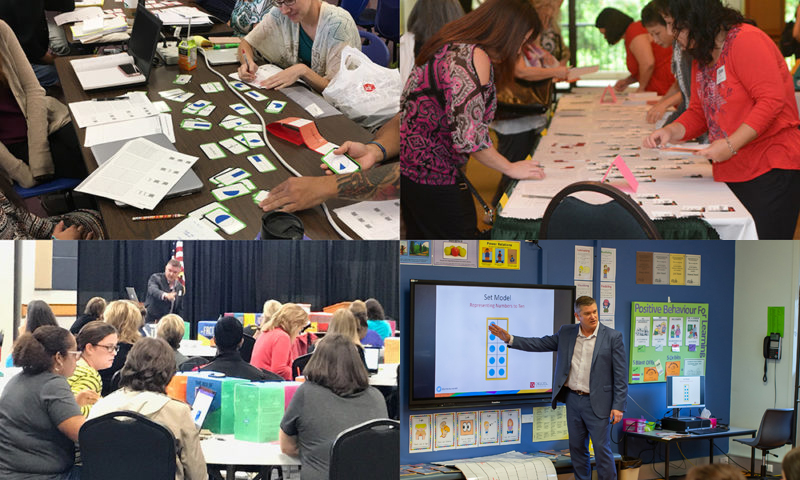
ORIGO Education Professional Learning (Pre-K Through Grade 6)
ORIGO Education’s professional learning opportunities are designed with teachers’ experiences in mind. Rather than focusing only on procedures or pacing guides, ORIGO’s PD centers on:
✔ Conceptual understanding
Teachers deepen their own mathematical understanding so they can teach with confidence and flexibility.
✔ Instructional strategies
ORIGO models research-based practices that promote reasoning, mathematical discourse, and student sense-making.
✔ Growth mindset integration
Professional learning includes reflective components that help teachers examine their beliefs and classroom messages about ability.
✔ Grade-level coherence
ORIGO helps teachers see how foundational ideas in early grades connect over time—promoting continuity and confidence as students progress.
Teachers who participate in ORIGO Professional Learning often report not just instructional growth, but a shift in how they feel about teaching math. When teachers feel supported and confident, their students benefit from clearer explanations, richer discourse, and a classroom culture that values exploration over anxiety.

Teacher Mindset and Student Outcomes: The Ripple Effect
A teacher’s math mindset is more than an emotional state; it’s a lever for student success. When teachers believe in their own capacity to learn and teach math, students adopt similar beliefs. They are more willing to ask questions, persist through challenges, and value reasoning over rote memorization.
Conversely, when math instruction is fear-based or avoidance-driven, students pick up on subtle cues that undermine confidence and persistence.
Supporting teachers with the tools to manage anxiety, deepen content knowledge, and embrace growth mindset is not optional — it’s essential to improving student achievement and engagement.

Moving Forward with Intention
Math anxiety among teachers is real, widespread, and impactful — but it is not fixed. Research shows that teacher mindset influences instructional practice and, in turn, student attitudes and achievement.
Intentional reflection, evidence-based instructional shifts, and high-quality professional learning experiences — especially those like ORIGO Education Professional Learning — can help teachers build confidence in math instruction. When teachers feel grounded in their own mathematical understanding and supported in their practice, they cultivate classrooms where students learn to think mathematically with joy and persistence.

 1-888-674-4601