


 1-888-674-4601


Insights
Tips for Building a Coherent K–6 Math Progression
As K–6 math educators, one of our most important responsibilities is ensuring that students move from concrete ideas in the early grades toward more abstract, powerful thinking in later grades. A coherent progression means that each year’s content both revisits prior ideas in deepened ways and also lays the foundation for upcoming work. When we get that right, kids feel continuity, not disconnection—and we reduce the “mismatch” that sometimes happens between grades.
Below are strategies and tips for designing or refining a strong K–6 math progression in your school, district, or classroom.

Why Coherence Matters More Than Ever
In recent years, U.S. math achievement has seen meaningful declines—especially since the disruptions caused by the COVID-19 pandemic.
- According to the National Assessment of Educational Progress (NAEP), average math scores for fourth graders in 2022 were 5 points lower than in 2019, and eighth graders dropped 8 points over the same period.
- These declines marked the largest decreases in U.S. math outcomes since 1990.
- In the long-term NAEP trend data, 9-year-old students scored 7 points lower in math in 2022 compared to 2020.
- Achievement gaps have widened—especially for lower-performing students and those from underserved communities.
These trends highlight why we can’t afford fragmented or disconnected instruction. Students need more than strong individual lessons—they need learning experiences that fit together as part of a bigger story. A coherent math progression ensures that each year’s content builds logically and intentionally on the last, so mathematical ideas develop in a connected, cumulative way. This kind of continuity helps close knowledge gaps, strengthens understanding, and gives teachers confidence that what they’re teaching today truly prepares students for what comes next.

A Sample K–6 Math Progression
Before diving into principles, let’s look at what coherence might actually look like across the elementary grades.
- Kindergarten–Grade 1:
- Build strong number sense through counting, comparing, and composing/decomposing numbers up to 20.
- Connect numbers to real-world contexts through story problems, objects, and manipulatives.
- Explore early addition and subtraction using concrete models (like counters or ten frames).
- Identify and describe basic shapes, sort objects by attributes, and explore simple measurement (length, weight).
- Grades 1–2:
- Strengthen fluency with addition and subtraction within 20, and extend to problems within 100.
- Develop understanding of place value in two-digit numbers as groups of tens and ones.
- Begin working with equal groups, arrays, and skip counting as a foundation for multiplication.
- Explore time, money, and data through charts, number lines, and real-world examples.
- Grades 2–3:
- Deepen understanding of place value through hundreds, tens, and ones.
- Build fluency with addition and subtraction within 1,000.
- Introduce multiplication and division as equal groups, arrays, and repeated addition/subtraction.
- Begin early fraction concepts through sharing, partitioning, and unit fractions.

- Grades 3–4:
- Strengthen multiplication and division strategies and develop fluency with basic facts.
- Extend understanding of fractions—equivalence, comparison, and simple operations.
- Apply area and perimeter to real-world and visual problems using arrays and grids.
- Develop reasoning with multi-step word problems.
- Grades 4–5:
- Operate confidently with fractions and decimals, connecting to prior work with whole numbers.
- Explore factors, multiples, and the relationship between multiplication and division.
- Connect measurement and geometry through volume, angles, and coordinate grids.
- Strengthen understanding of place value into the millions and thousands.
- Grades 5–6:
- Extend number understanding to include integers and rational numbers.
- Deepen proportional reasoning, ratios, and rates—linking to early algebraic thinking.
- Represent and analyze relationships with expressions, equations, and coordinate pairs.
- Interpret and display data using line plots, histograms, and box plots.
Each stage connects meaningfully to the one before it, so students aren’t learning isolated skills but building a continuous and connected understanding of mathematics.

Principles and Practices for a Coherent K–6 Math Progression
Designing a truly coherent math experience requires both big-picture principles and practical strategies for implementation. The following framework blends both—so that theory translates directly into classroom practice.
1. Build on Core Concepts Year to Year
Identify the “big ideas” (number sense, operations, fractions, geometry, measurement) and ensure students revisit them annually in deepened ways.
- Use progression maps to visualize how each concept grows across grades.
- Plan lessons that explicitly connect current content to what students already know.
2. Promote Vertical Alignment and Collaboration
Encourage ongoing communication between grade levels so teachers understand what comes before and after their content.
- Hold vertical team meetings where teachers examine standards, student work, and common misconceptions.
- Co-create shared units or anchor tasks that connect learning across years.

- Teachers meeting
3. Make Connections Explicit for Students
Don’t assume students will automatically see how ideas relate—teach those links intentionally.
- Use anchor problems that reappear in new forms each year.
- Revisit core representations (like number lines, area models, and arrays) at increasing levels of abstraction.
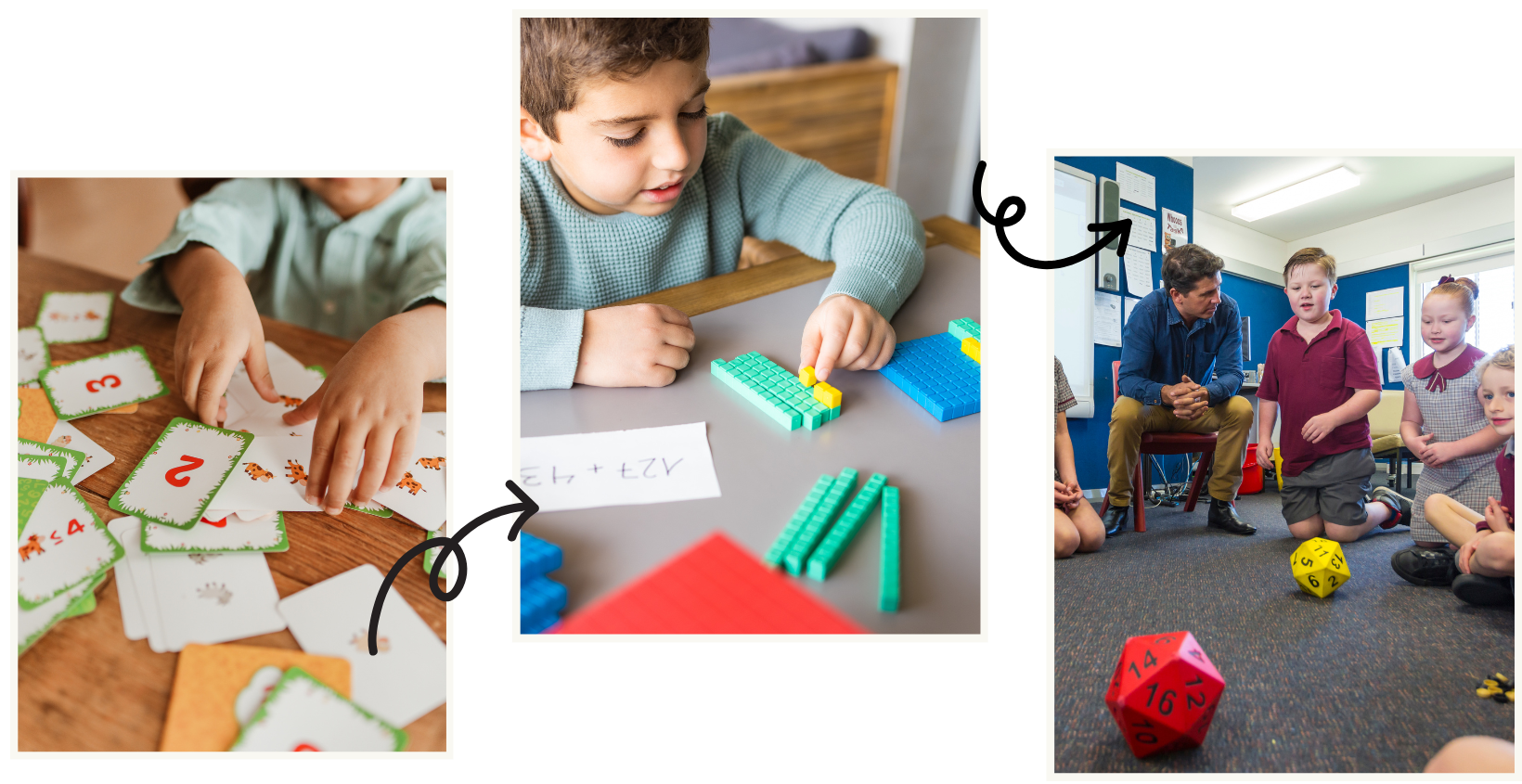
4. Scaffold from Concrete → Pictorial → Abstract (CPA)
Manipulatives, models, and drawings are vital stepping stones toward symbolic reasoning—especially in early grades.
- Introduce each concept with hands-on exploration, then move to visual representations, and finally to equations or symbols.
- Check for conceptual understanding before emphasizing fluency.

5. Plan for Conceptual Misconceptions
Identify common stumbling blocks early (e.g., regrouping in subtraction, fraction equivalence) and design instruction that surfaces and resolves them.
- Build diagnostic checkpoints into the start of each unit to uncover prior misunderstandings.
6. Spiral and Reinforce Learning Throughout the Year
Knowledge fades without review. Coherent progressions intentionally cycle back to key ideas.
- Schedule review days or integrate warm-up tasks that revisit prior standards.
- Use short, engaging games or number talks to strengthen retention and flexible thinking.
Try the Spaced-Learning technique. Learn more here!
7. Use Formative Assessment to Guide Progression
Coherence depends on accurate insight into what students know and can do.
- Use exit tickets, student reflections, and quick performance tasks to track learning across grades.
- Adjust pacing or scaffolding based on formative results—not just pacing guides.
8. Collaborate and Reflect Continuously
A coherent curriculum isn’t built overnight. It’s refined through teacher feedback, classroom experience, and student data.
- Treat your progression as a living document that evolves each year.
- Celebrate when vertical alignment leads to visible gains in student confidence or fluency.
By combining these guiding principles with concrete steps like shared planning time, spiral review, and formative assessment, teachers can bring coherence to life in a way that directly impacts student growth.

Stepping Stones 2.0 Supports a Coherent K–6 Math Progression
ORIGO Education’s Stepping Stones 2.0 was built with coherence at its core. This comprehensive K–6 math program ensures that each lesson connects meaningfully to prior learning while preparing students for future concepts.
Here’s how Stepping Stones 2.0 supports a seamless progression:
- Intentional Vertical Alignment: Every unit builds on the conceptual groundwork of earlier grades, reinforcing understanding instead of reteaching disconnected skills.
- Concrete to Abstract Learning Path: Lessons transition naturally from hands-on models to visual representations to symbolic reasoning, supporting deep conceptual growth.
- Built-In Review and Reinforcement: Each lesson includes practice and problem-solving activities that revisit earlier content, strengthening retention and fluency.
- Clear Teacher Guidance: Detailed lesson plans, professional learning videos, and digital supports help educators understand the “why” behind each concept.
- Alignment to Standards: The sequence follows research-based learning progressions that align with major U.S. standards, making it easy to maintain consistency across grades.
ORIGO Education’s Stepping Stones 2.0 provides the structure, guidance, and resources educators need to make that vision a reality—so every student can build a strong, connected foundation in mathematics. When schools adopt Stepping Stones 2.0, they gain more than just a curriculum—they gain a cohesive framework for building mathematical understanding from Kindergarten through Grade 6.
In all, building a coherent K–6 math progression takes planning, collaboration, and commitment—but the payoff is lasting. When instruction is connected, students develop confidence and curiosity, teachers feel supported, and schools create a true sense of mathematical growth across the grades.

 1-888-674-4601