


 1-888-674-4601


Insights
Making Sense of Mid-Year Math Data: What Matters Most?
By the middle of the school year, most of us are swimming in data. Benchmark scores, progress monitoring reports, unit assessments, exit tickets, observation notes—it all starts to pile up right around the same time energy dips and pacing pressure increases. As elementary math teachers, we know mid-year data matters. The question is how to use it well without letting it overwhelm us or drive instruction in unhelpful ways.
Mid-year math data shouldn’t feel like a verdict on your teaching or your students. Instead, it’s a snapshot—one that can help you reflect, adjust, and plan intentionally for the months ahead. When we focus on what truly matters, data becomes a tool for clarity rather than stress.

Why Mid-Year Data Feels So Heavy
At this point in the year, you’ve taught a significant portion of your curriculum. Some students are thriving, others are stuck, and many are showing uneven progress depending on the concept. Mid-year data often highlights gaps that feel urgent, especially in foundational areas like number sense, place value, and basic operations.
It’s easy to jump straight to the question: “What do I need to reteach?” But before making instructional decisions, it helps to slow down and ask a more important one: “What is this data actually telling me?”

What Mid-Year Math Data Can (and Can’t) Tell Us
Mid-year math data can be incredibly helpful—but only if we understand its limits.
What it can tell us:
- Which concepts students have had enough exposure to—and which they haven’t
- Patterns across the class (for example, many students struggling with regrouping or fractions)
- Which students may need targeted support or enrichment
- How well students are transferring understanding from one context to another
What it can’t tell us:
- Everything a student knows about math
- How a student reasons if the assessment focuses only on answers
- Whether a student is capable of learning a concept they haven’t fully mastered yet
- The full story behind a wrong answer
Mid-year assessments often emphasize efficiency and accuracy, which are important—but they don’t always capture conceptual understanding. That’s why it’s essential to pair formal data with what you already know from classroom discussions, models, student explanations, and problem-solving tasks.

Look for Trends, Not Just Scores
One of the most productive ways to approach mid-year data is to zoom out. Instead of focusing on individual scores first, look for trends.
Ask yourself:
- Are students consistently struggling with a particular representation?
- Do errors point to misconceptions or incomplete understanding?
- Are students using inefficient strategies, even when answers are correct?
For example, if students can compute accurately but struggle to explain their thinking or model their work, that signals a need to strengthen conceptual understanding—not just practice more problems. Data becomes far more useful when it helps you identify how students are thinking, not just what they got right or wrong.

Using Data to Inform Instruction—Not Interrupt It
Mid-year data shouldn’t derail your instruction. Instead, it should fine-tune it. Small adjustments often have a bigger impact than large overhauls.
This might look like:
- Re-grouping students temporarily for targeted support
- Revisiting a key concept through a different representation
- Adding focused number talks or problem-solving discussions
- Using games or practice tasks that reinforce specific ideas
When instruction is built on a coherent progression of concepts, these adjustments feel more manageable. Teachers aren’t reteaching randomly; they’re strengthening connections between ideas students have already encountered.

Why Spaced Learning Matters When Responding to Mid-Year Data
One of the most effective ways to respond to mid-year data—without slowing instruction—is through spaced learning. Instead of reteaching a concept once and moving on, spaced learning intentionally revisits key ideas over time, allowing students multiple opportunities to strengthen understanding. This approach aligns well with how students actually learn: concepts become more durable when they’re encountered, practiced, and applied across different lessons rather than in a single block.
Mid-year data can help identify which concepts need to be revisited, but spaced learning helps determine how to revisit them. A brief review task, a targeted discussion, or a problem that connects a previous concept to new learning can be enough to reinforce understanding.
ORIGO’s curriculum and resources are intentionally designed with this in mind—key concepts are revisited across lessons, units, and grades using varied representations, discussion prompts, and practice tasks. Because practice is embedded and purposeful rather than repetitive, spaced learning happens naturally in the classroom without adding extra lessons or interrupting the flow of instruction.
This way, teachers can respond to mid-year data by leaning into the structure already in place—using short practice tasks, games, or problem-solving discussions to strengthen understanding over time, rather than stopping to reteach content in isolation.

The Role of Ongoing, Embedded Assessment
Mid-year data also works best when it’s not the only data point you rely on. Daily formative assessment—listening to student conversations, analyzing strategies, reviewing work samples—often tells you far more than a single benchmark.
Curricula that embed assessment opportunities within lessons make this process more natural. When lessons include purposeful questions, discussion prompts, and opportunities for students to explain their thinking, teachers gain constant insight into understanding and misconceptions. Over time, this creates a more complete picture of student progress.
How ORIGO Education Supports Meaningful Insight Into Student Learning
ORIGO Education’s approach to mathematics is built around a coherent progression of learning, which naturally supports teachers in monitoring student progress over time. Lessons are intentionally designed to develop conceptual understanding before moving toward procedural fluency, making it easier to see how students’ thinking evolves and where additional support or emphasis may be needed.
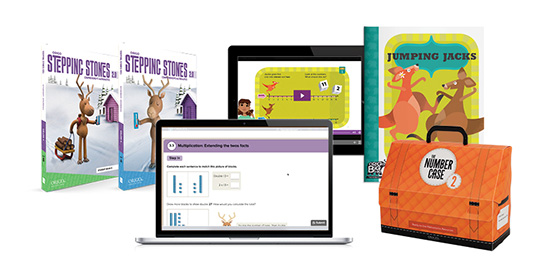
With resources like Stepping Stones, teachers can follow student growth through lesson-based tasks, classroom discussions, and formative checkpoints that are embedded directly into instruction. Rather than relying solely on end-of-unit tests, teachers gather evidence of understanding throughout the learning process. This ongoing insight allows for responsive teaching—adjusting instruction, grouping, and support based on what students show they need.
Because concepts are revisited and extended across grades, teachers can also see how understanding develops over time. This makes mid-year data feel more like a guidepost within a larger learning journey.

Making Data Work for You (Not the Other Way Around)
It’s worth remembering that data exists to support teaching—not to replace professional judgment. As the teacher in the room, you bring context that no spreadsheet ever will. You know which students freeze during tests, which thrive in discussion, and which are still developing confidence.
When you combine mid-year data with:
- Classroom observations
- Student explanations
- Work samples
- Knowledge of curriculum progression
you gain a powerful foundation for instructional decisions. When mid-year data is interpreted with all of the above in mind, it naturally informs how instruction can build—rather than restart—during the second half of the year.

Planning for the Second Half of the Year
As you plan for the second half of the year, mid-year data can help you prioritize which ideas need continued attention—but it doesn’t require a complete reset. Instead of rebuilding units or front-loading review, use the data to prioritize what matters most next.
Consider:
- Which concepts are foundational for upcoming units?
- Where can you spiral support without stopping progress?
- Which students need targeted intervention—and which need enrichment?
A curriculum that emphasizes connections between ideas makes this planning easier. Through short warm-ups, math talks, games, and purposeful practice, key skills can be strengthened over time using a spaced approach. When students revisit concepts in new contexts, there are built-in opportunities to strengthen understanding without reteaching entire units.

Using Mid-Year Data to Move Learning Forward
When learning is revisited across weeks and units, students have repeated opportunities to refine strategies, make connections, and deepen understanding. Curricula built on a coherent progression make this work especially well, allowing teachers to respond to mid-year data by adjusting emphasis rather than slowing pacing or starting over. With spaced learning intentionally woven into instruction, the second half of the year becomes less about catching up—and more about building understanding that lasts.
Mid-year math data is about insight. When viewed thoughtfully, it helps teachers fine-tune instruction, support students with purpose, and move forward with clarity. You don’t need to analyze every number to make meaningful change. Look for patterns, trust your professional expertise, and use data as one part of a much larger instructional picture.

 1-888-674-4601